How to Create a Valid UTF-8 CSV File for Importing
In this article
Save your import file as a UTF-8 CSV so YoPrint can read names, descriptions, and other text correctly. UTF-8 preserves accented letters, such as the é in Café, and characters from other languages. The .csv extension identifies the file type; it does not guarantee UTF-8 encoding.
Keep your working spreadsheet separately. Saving a copy as a CSV creates a file containing plain text values from that single sheet. A CSV copy does not preserve other worksheets or unsaved edits, so keep your original workbook. YoPrint accepts UTF-8 files saved with or without a Byte Order Mark (BOM). Use the section below for your spreadsheet or text app.
Preserve phone numbers and codes
Spreadsheets often remove leading zeros from phone numbers or postal codes, and convert barcodes into scientific notation. Format columns containing phone numbers, postal codes, or barcodes as Text before typing or importing values, because applying text formatting later does not restore lost digits.
Google Sheets (Web)
Google Sheets screens
These steps happen in Google Sheets. Its screens may have changed since these pictures were taken. See Google’s guide to downloading a file.
Open the sheet containing your filled YoPrint template.
-
Open the File menu.
-
Point to Download.
-
Choose Comma Separated Values (.csv).
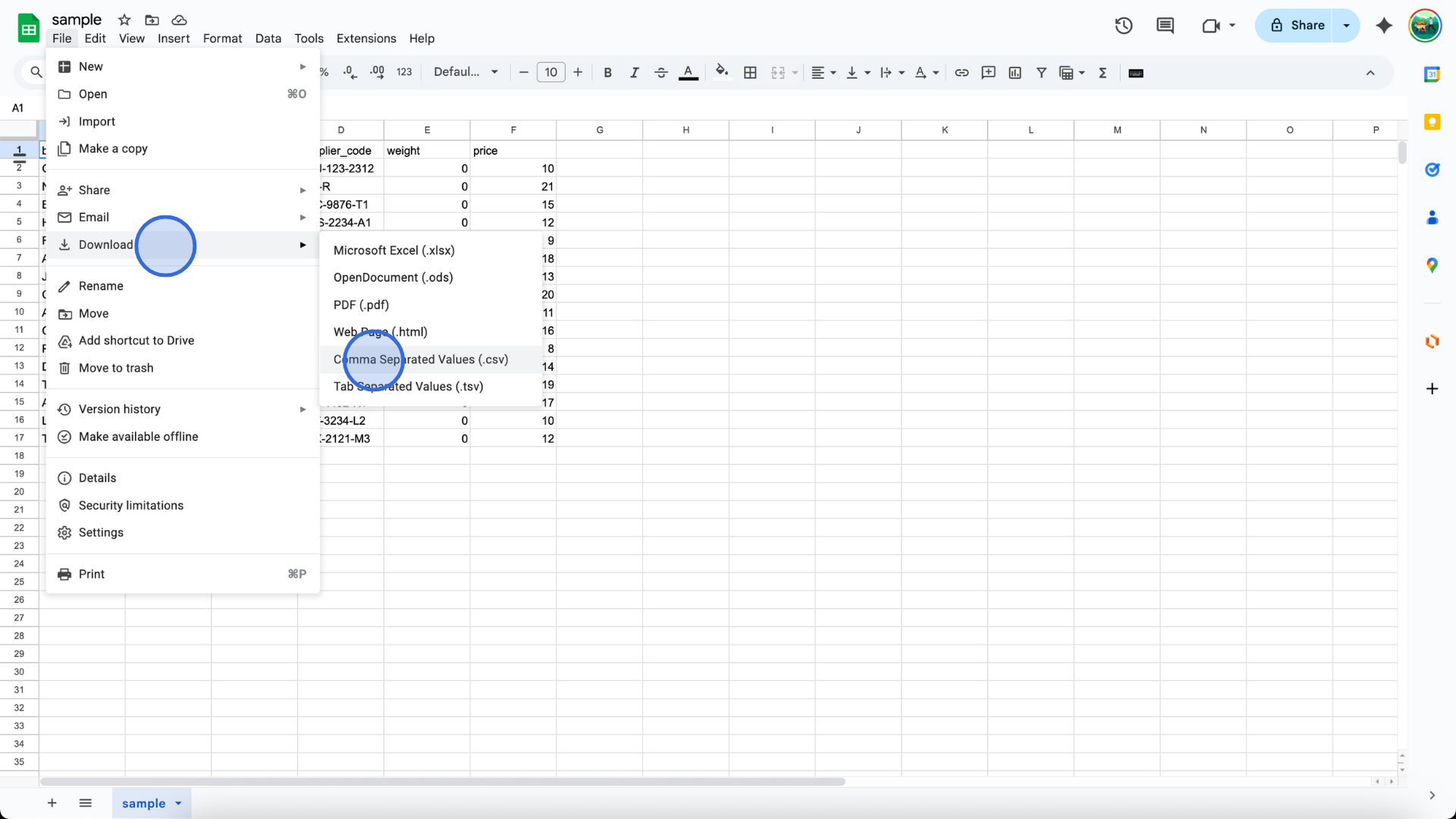
Google Sheets downloads a UTF-8 CSV. You do not need to choose an encoding. Because a CSV file holds only one sheet of plain text, download each import sheet separately.
Microsoft Excel on Mac
Microsoft Excel screens
These steps happen in Microsoft Excel. Its screens may have changed since these pictures were taken. See Microsoft’s guide to saving a CSV and Excel for Mac file formats.
Open the worksheet containing your import data.
-
Open the File menu.
-
Choose Save As.
-
Open File Format.
-
Select CSV UTF-8 (Comma delimited) (.csv).
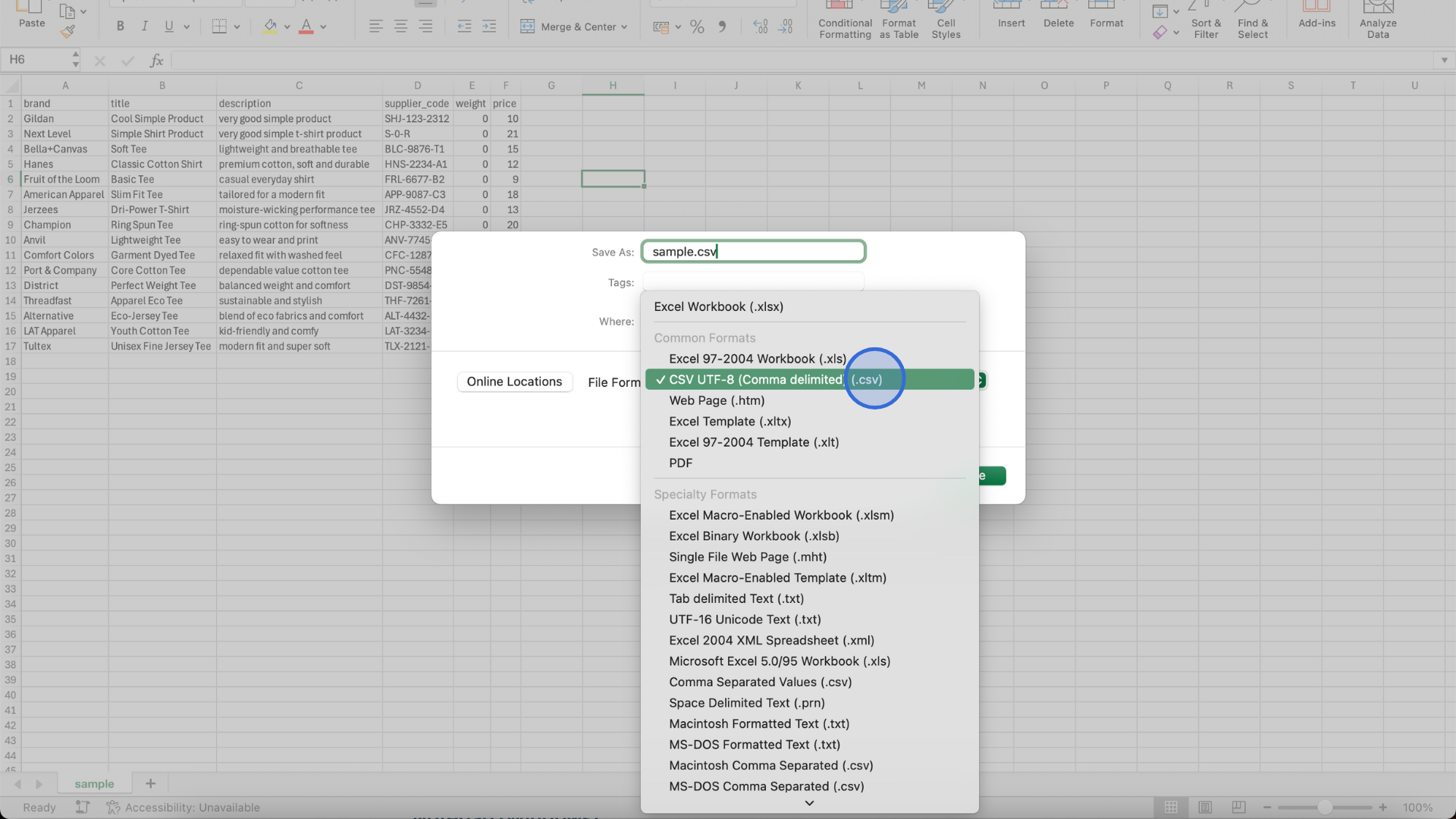
-
Give the copy a filename ending in .csv.
-
Click Save.
If Excel warns about features that CSV cannot keep, choose to keep the CSV format. Saving saves only the active sheet into the new CSV file. Keep your original workbook, because a CSV file does not save other worksheets or unsaved edits.
Microsoft Excel on Windows
Microsoft Excel steps
These steps happen in Microsoft Excel. Follow Microsoft’s CSV-to-UTF-8 instructions if the menus differ in your version.
Open the worksheet containing your import data.
- Open the File menu.
- Choose Save As.
-
In Save as type, select CSV UTF-8 (Comma delimited) (*.csv).
Do not choose standard CSV
Excel lists multiple CSV formats. Check your spreadsheet's export options and select the explicit UTF-8 format rather than standard CSV. If your file contains invalid UTF-8 bytes, YoPrint will reject it. Always choose CSV UTF-8 (Comma delimited) (*.csv).
- Enter a filename for the import copy.
- Click Save.
For an existing CSV whose text displays garbled characters, use Data > From Text/CSV to open it. In File Origin, select the encoding that makes your text readable in the preview window. Click Load, then save the file as CSV UTF-8 (Comma delimited) (*.csv). Microsoft’s linked guide walks through this conversion.
Notepad (Windows)
Notepad steps
These steps happen in Windows Notepad. Microsoft describes its UTF-8 support in the Notepad updates guide.
Open your CSV file in Notepad and check that its text is readable. Keep its commas, quotation marks and line breaks intact.
- Open the File menu, or use the keyboard shortcut in step 2.
- Choose Save As. You can also press Ctrl + Shift + S.
- In the encoding options, select UTF-8.
- If available, set Save as type to All files (.), and ensure the filename ends in .csv.
- Click Save to save the copy.
Check that your saved file ends in .csv, not .csv.txt. Return to YoPrint with that saved copy.
TextEdit (Mac)
TextEdit screens
These steps happen in Apple TextEdit. Its screens may have changed since these pictures were taken. See Apple’s guide to plain text documents and TextEdit’s encoding settings.
Open your CSV in TextEdit. The file must be plain text, with its commas and line breaks preserved.
-
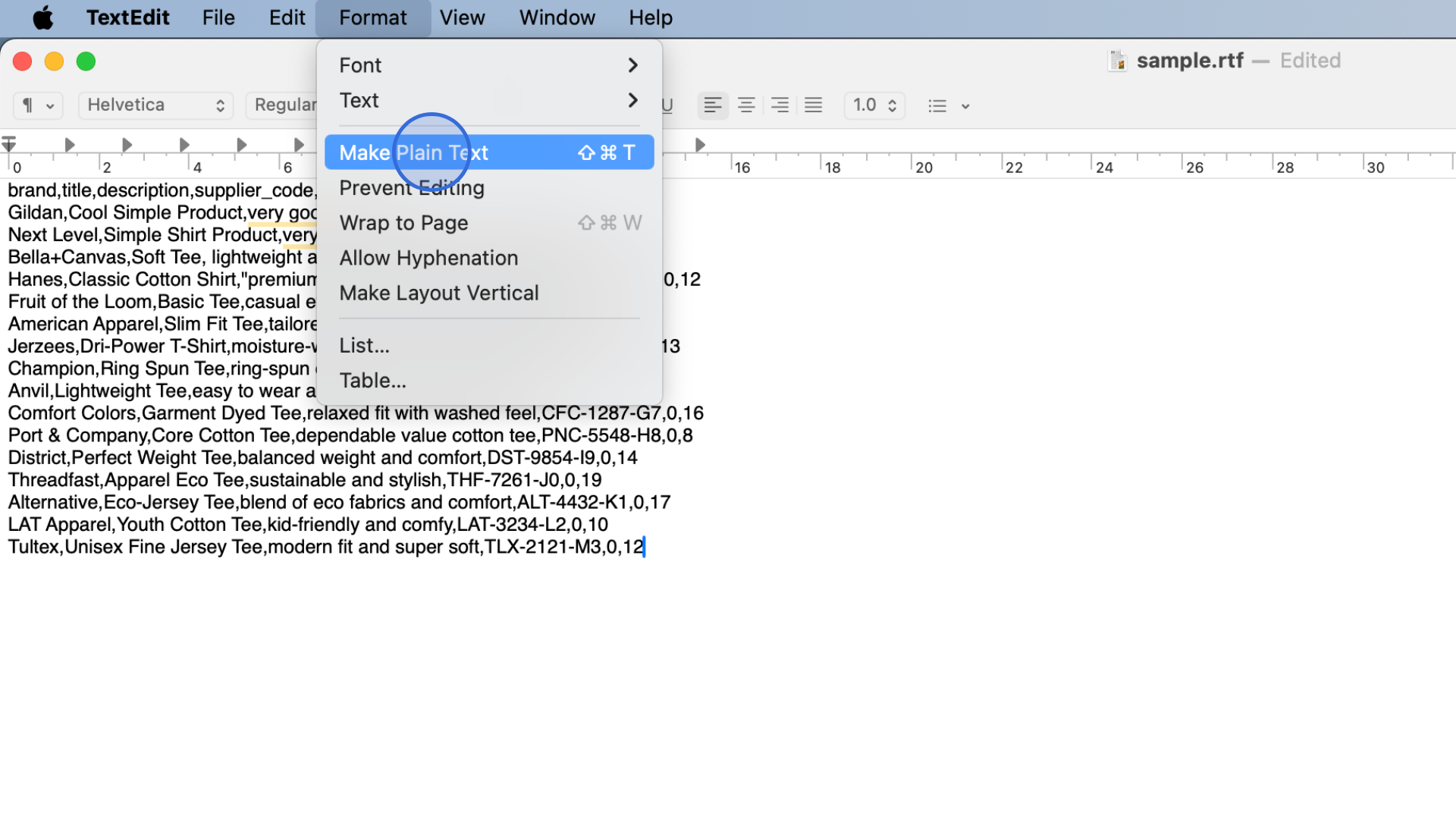
Open the Format menu.
-
Choose Make Plain Text if the document is rich text. The shortcut is Shift + Command + T. If the menu says Make Rich Text, the document is already plain text.
-
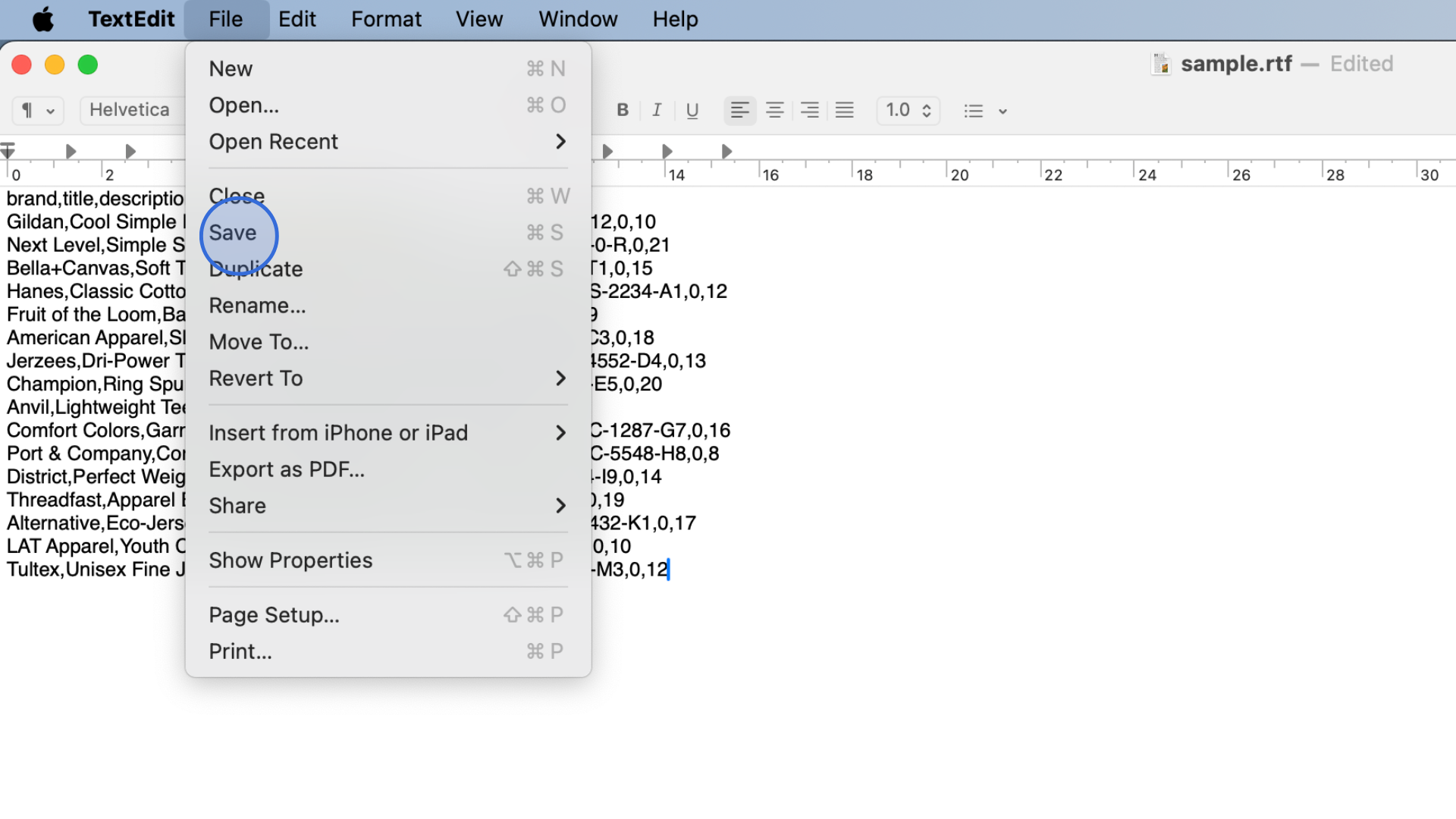
Open the File menu.
-
Choose Save, or hold Option and choose Save As to save a separate copy.
-
Set the plain text encoding to Unicode (UTF-8) when saving.
Plain text encoding settings
If the encoding option is not visible in your save dialog, you can use TextEdit > Settings > Open and Save to set the default encoding for saving plain text files.
-
Name the file with a .csv extension. If prompted about the file extension, choose to keep
.csv. -
Click Save.
Check the filename before returning to YoPrint. A rich text file renamed to .csv is still rich text; use plain text for the file contents.
Check the file in YoPrint
Upload your saved file through the matching import screen in YoPrint:
- Products: Go to Configuration > Products, click Import Products, and choose Import Simple Products or Import Variant Products. See Import Products Using a CSV Template.
- Customers: Go to Sales > Customers and click Import Customers. See Import Customers Using CSV.
- Vendors: Go to Stock Control > Vendors and click Import Vendors. See Import Vendors Using CSV.
YoPrint validates the file encoding when you click Continue on the Upload CSV screen. If the file contains invalid UTF-8 bytes, the portal displays an error message and blocks the import before mapping.
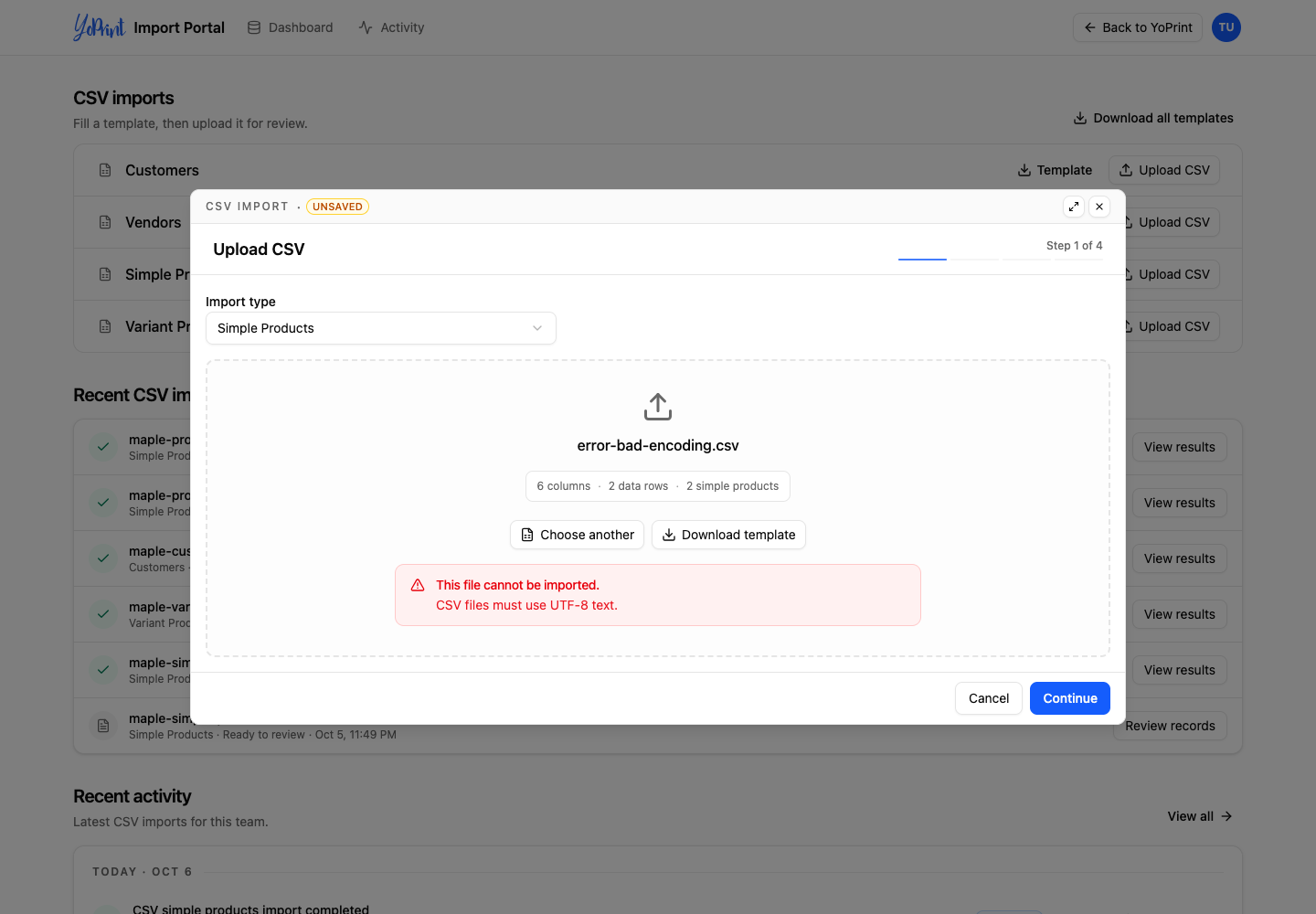
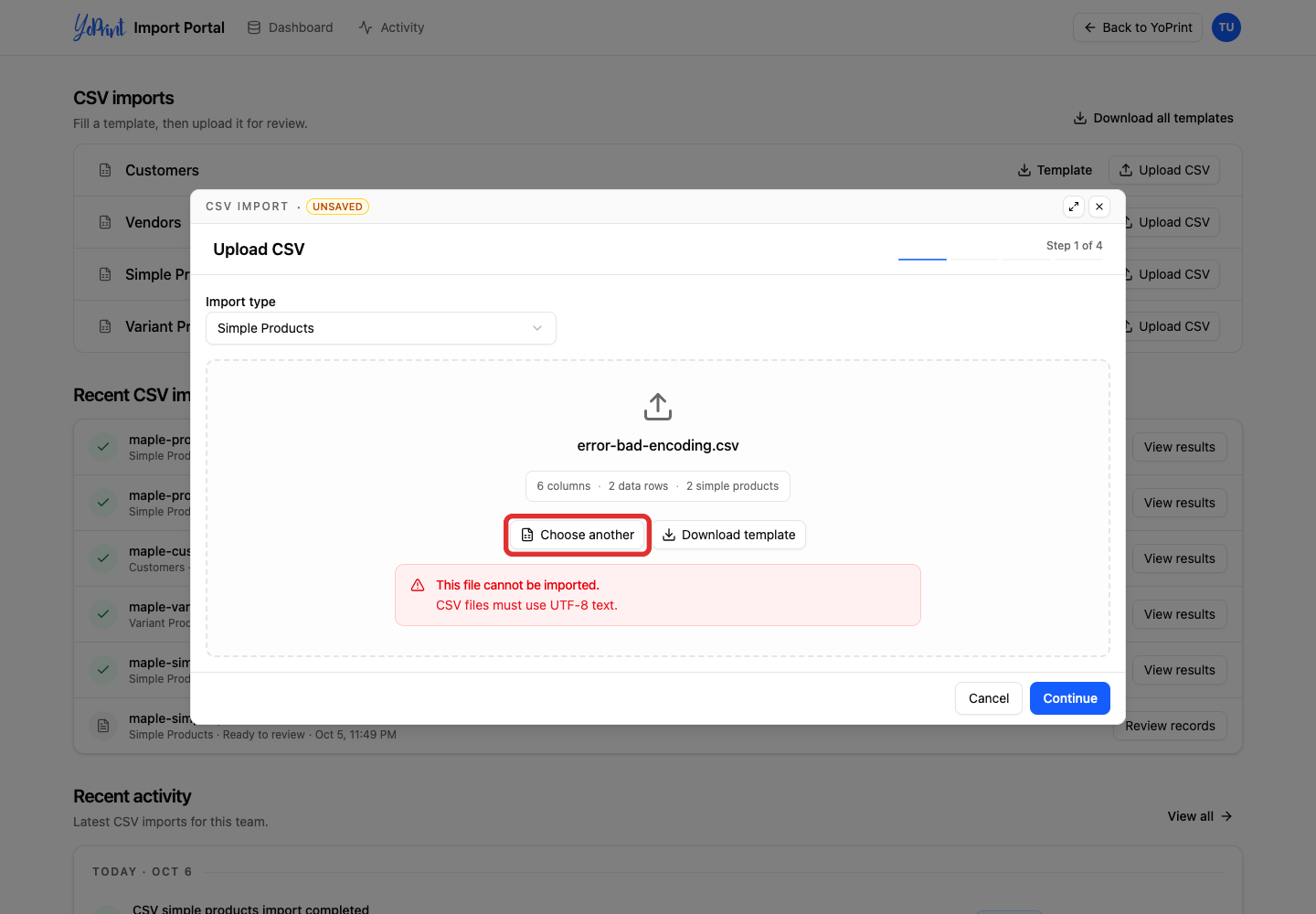
If the portal displays This file cannot be imported. CSV files must use UTF-8 text., save another copy with the UTF-8 option in your spreadsheet or text app. Click Choose another to select the corrected file.
Once you click Continue with a valid file, the portal advances to Map fields. Inspect the preview values, especially names with accents or non-English characters. If characters appear garbled (such as Café or Caf? instead of Café ), the text was saved or decoded incorrectly before reaching YoPrint. Check that your original spreadsheet still displays the characters correctly, then export a fresh UTF-8 copy.
For missing columns or row errors, see Troubleshoot CSV Import Errors.